Tuesday, January 28, 2014

Liquor Without The Hangover - Rancho Bonanza, Ecuador

Finding quality beer in Latin America is starting to become a little easier! You may remember our trip to the brewery in Buga, Colombia to hunt down some good IPA. Two months later we managed to find a restaurant/campground/brewery outside of the gritty town of Portoviejo, Ecuador, called Rancho Bonanza. We found Rancho Bonanza thanks to our friends from The Long Way South, who stumbled upon it on TripAdvisor, while looking for a place to eat and camp for the night.


Joe (aka Joaquim), the owner of the brewery, is a German guy who moved to Ecuador 20 years ago. His beer brewing exploits started after he spent some years distilling liquor - namely whiskey. The sign outside of his distillery says "Licores sin chuchaqui" (Liquor without a hangover). My guess is that he can't say the same for his beers.

Given that Joe is German, it was no surprise that his brews lean towards the smooth and malty end of the scale - no Cascade hops for this guy! On our second visit to his brewery he offered us a taste of his latest lager. It was delicious (one of our favorites), with a stronger hop undertone than his other beers. Joe let us know that this one wasn't his favorite, as it's IBU (International Bitterness Unit) rating was a bit high, at 35. We chuckled, given most of the beers we covet in the USA have IBU ratings between 70 - 110. Lucky for us, we also have an appreciation for the more subtle beers that Joe brewed!

Joe's main business at the moment is manufacturing large scale micro brewing equipment.

During both of our visits, Joe allowed us to camp on his property for free. But as you know, nothing in life is truly free. He gave us free reign of the tap as long as we kept track of how many we drank. Joe definitely got paid.


Our second visit to the brewery happened after our 12-volt fridge developed a refrigerant leak. We immediately emailed Joe and asked him if he knew of a refrigeration technician. Sure enough, he told us he would have his guy meet us at his place anytime we wanted. Carlos was an eager and helpful technician, but was only able to get so far with fixing the fridge. He didn't have experience with 12-volt fridges, which are extremely sensitive to refrigerant charge. Carlos wanted to give up at the end of the second day, but Scott talked him into coming back the next morning. When he arrived, Scott bought Carlos' tools and finished the job himself. A+ for effort Carlos...

Joe, Carlos, and Scott on Day 1
Scott's setup, Day 3. Joe let him borrow his scale and a cool laser thermometer gun

Having Joe's place to work on the fridge was incredibly helpful. He's the type of resource that every overlander dreams of finding. We left Rancho Bonanza with a sigh of relief, as we finally had a cold fridge (after 2 weeks without one), and 2 cases of cold lager to put in it. As a side note: if anyone is looking for a good 12-volt refrigeration technician, Scott's your man!


Monday, December 30, 2013

Our First Taste of the Ecuador Coast - Leaving the Mountains of Ecuador

As we drove from the central Andean mountains to the coast of Ecuador, it took a measly 50 miles to drop from 12,000 ft to 1,500 ft in elevation (steep!). A cursory check of our living quarters revealed water dripping down the mirror. The interior of our cabinets were wet, as were our clothing and food containers. This was a true lesson in the physics of humidity and condensation.

The drive from Quilatoa to Santa Marianita took us 9 hours. The total driving distance was only 180 miles!!! There was a bit of construction, a few very badly pot-holed sections, some sloooow twisty mountain roads, and of course, lots of awesome new roads. Interestingly, Ecuador is paving and/or repaving all of their roads, and for the most part, have the best roads we've driven in the Americas.

Over the following couple of weeks, we slowly worked our way down the coast hoping for some surf. We found some stunning, secret camping spots. The first was just north of Punta San Lorenzo where we had a quiet and peaceful night of sleep.

Outside of San Lorenzo

Just a bit south we happened upon another gorgeous beach with a quiet, free camping spot. The best part was the characters we met when we arrived. They had just camped for 5 days at this beach and were packing up to leave. They were 2 young French guys and 2 Argentinians traveling in a VW Bug. Their car battery was dead, a rear tire was flat, and their jack was broken.  No worries. Scott loaned them our jack, they changed the tire, and per their usual routine, 3 of them push started the car, in reverse, as they left.

Scott supervising the push start

Loaded down and ready for adventure

La Policia - pic courtesy of Wikipedia
An odd thing happened on our 3rd night camping here. Nate and Sarah showed up and decided to spend the night, as well. As the sun was setting, la policia truck arrived.  One of the officers flippantly told Sarah (who was on the beach) that we couldn't spend the night. Then, quickly drove off. We found them parked a little bit down the beach where we asked for more info. Something about it being "owned by the community" and "not safe". This seemed awfully fishy, but we really had no choice. Luckily there was a nice campground about a mile up the road overlooking our prior camp spot. It wasn't as nice as parking right at the beach, but it did have a nice view of the ocean and Salango Island. There, we learned that the beach spot was not owned by the community, but by a Swiss guy who lives in Guayaquil. Later, we read a blog post from an overlanding family who had a picture of our "secret" camp spot. I guess it's not so secret and I also guess la policia are not too diligent about kicking people out. A week and a half later we stayed at the camp spot for another 2 nights without incident.

La policia beach

A view from the Isla Mar campground that we retreated to, after getting kicked off the beach
Continuing to take advantage of Ecuador's free national parks, we hit Los Frailes beach in Machalilla NP. Here, we found a beautiful white-sand beach without a speck of trash. We spent the entire day at the beach hiking, snorkeling, and swimming. Unfortunately, the rules stated we had to leave the park by 4:30 pm.

Los Frailes beach

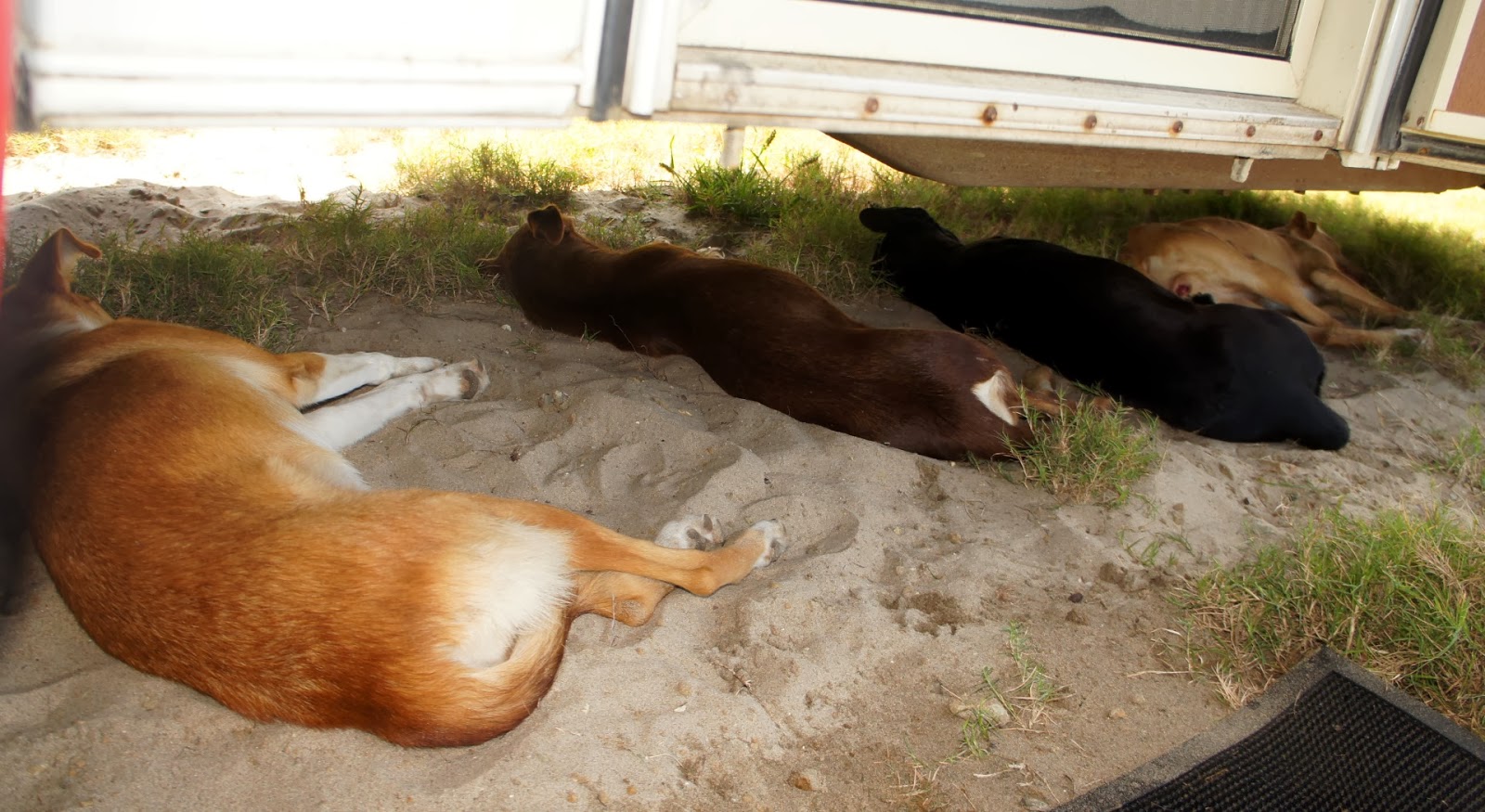
Since there were waves in the forecast, we drove south to the famous surf spot at Montañita. We feared that it would be hard to find a nice camp spot like those to which we had become accustomed, so we arrived prepared for disappointment. Montañita is known as a "party town" and has a pretty developed scene of random beach side accommodations, bars, and restaurants. We couldn't believe it when we found a camping spot on the beach, right in front of an abandoned public amphitheater (see pic), and most importantly, right in front of the surf break. We fed the local beach dogs and had some barking security, too.

Montañita beach camping

The security team

Cow vs. dog stand-off in Montañita

The waves did arrive and we got a bit of surfing in before we left, due to the crowds. A few days later, we started another beer mission, similar to our Buga pilgrimage. Stay tuned for our inland detour to the microbrewery/distillery of Rancho Bonanza.

Monday, December 23, 2013

Free National Parks in Ecuador!?

After leaving Colombia, where national park entry fees for foreigners were around $20 per person, we were delighted to discover that Ecuador made entry to their national parks free as of January 2012! Yet another reason to love this country. Besides the obviously selfish benefit for us, it is fantastic that locals can more easily enjoy their country's natural beauty. The parks are no longer just for people with disposable income.

We visited our first national park just outside of Otavalo, at Laguna Cuicocha (10,650 feet in elevation). It was one of our favorite so far. Despite the heavy thick clouds that covered the lake and the towering volcano behind it, we were still awestruck by its beauty. Cuicocha (cui = guinea pig) + (kucha = lake) was given this name due to the guinea pig shape of the largest island in the middle of the laguna. Have a look at the pictures, and you can be the judge:


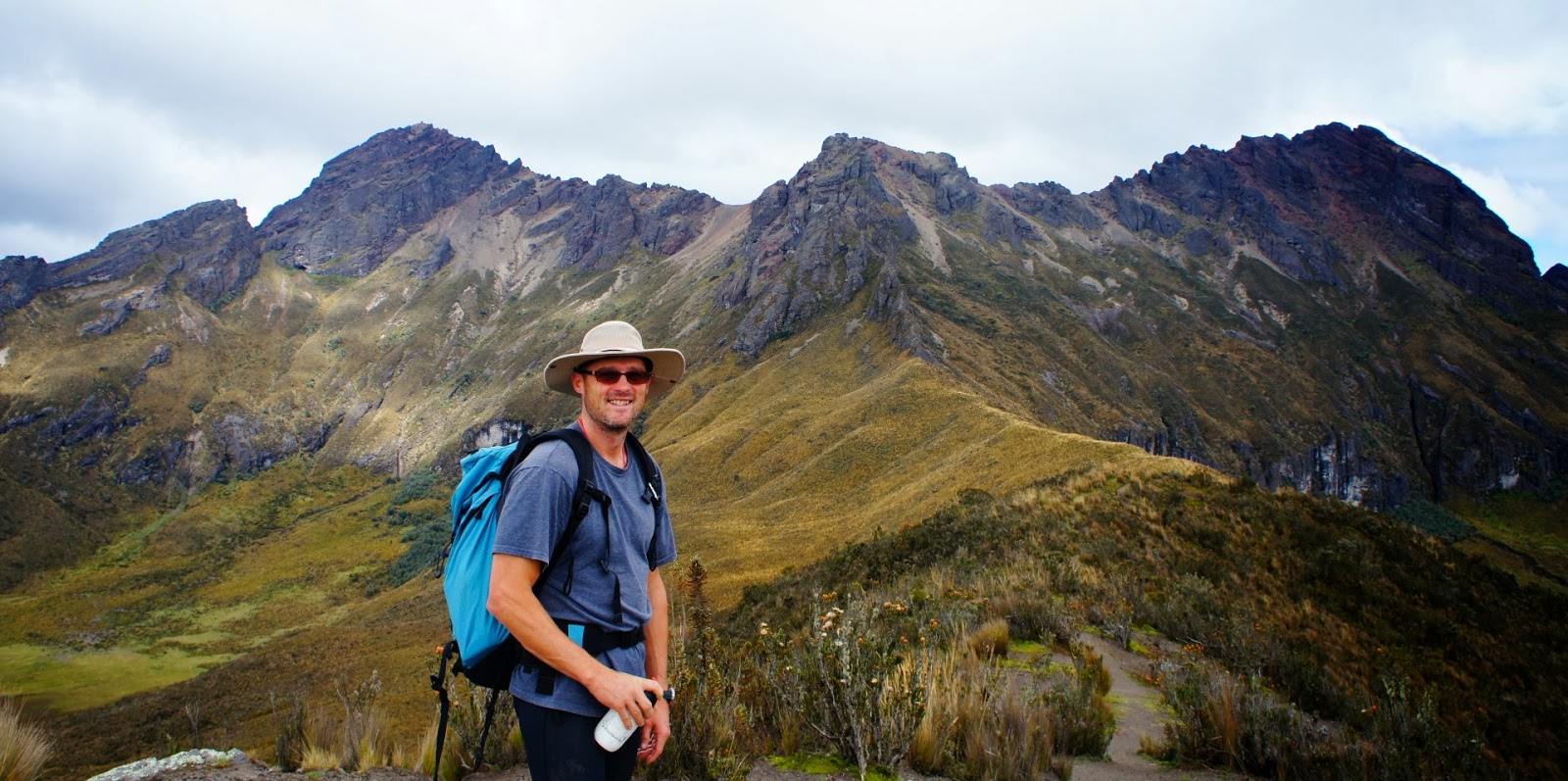
Our next stop was the national park surrounding the second highest volcano in the country, Volcan Cotopaxi, at 19,347 ft. We had the pleasure of sleeping in the cool mountain air, at 12,700 ft, in a parking lot near the volcano. Our new alpaca blanket was put to good use. Instead of trying to walk up to the snow line on Volcan Cotopaxi, which was covered in a thick cloud about 90% of the time, we hiked to the top of the neighboring volcano, Volcan Rumininahui. We were pleased to make it to our highest elevation yet, by foot, at 15,300 ft.

Volcan Cotopaxi came out for an amazing sunset glow, dwarfing El Tigre (lower left).

Bundled up for morning coffee with the majestic Cotopaxi making another appearance

Chilly morning with the object of our climb in the background - we only climbed the smallest of the 3 peaks in the picture

Laguna Limpiopungo. In unfavorable conditions, this water appears muddy, shallow, and a little ugly.
In the calm morning, it is a mirror for Volcan Rumininahui.

We made it as high as we could go on Volcan Rumininahui

As we approached 15,300 ft, I had to bust out the ear warmers and the arm warmers. Stylin' indeed.

We drove from Cotopaxi to yet another stunning volcanic crater lake called Laguna Quilatoa. This laguna is not part of a national park, but is actively managed by the local community. The local bossman greeted us as we drove up, and invited us to park for the night near the main parking lot (for free). The following day, we walked around the lake on a rather strenuous hike. The views were out of this world. As a side note, it wasn't until a few days ago that we realized we were using our polarized filter exactly 90 degrees out of phase - the laguna pictures still turned out pretty good.

Our first picture of the morning, before the clouds started coming in.
You can barely make out Volcan Cotopaxi in the far distance.

The color of the laguna changed with our location along the crater and the lighting throughout the day

You can barely make out the hairline hiking trail that follows the tortuous ridge around the crater

With diesel at $1/gal (have I mentioned this?), and free national parks, we may just have to try and visit all of them. Next up, Parque Nacional Machalilla.

Tuesday, December 17, 2013

Otavalo, Ecuador - Big Market and New Sights

We spent our first week in Ecuador hanging out at a great camp spot outside of the famous "market" town of Otavalo. At 9,400 ft above sea level, the camp spot (Rose Cottage) was nearly 1000 feet above the town. We had awesome views of the surrounding volcanos as well as the city. It also happened to be the place where our new friends, The Long Way South, were posted up for the week.

Strategically placed bench at Rose Cottage

Our happy hour view - the city of Otavalo with the moon rising over Mt. Imbabura 

Otavalo claims to host the largest market in all of South America. It's most famous for beautiful woven products including blankets, ponchos, sweaters, hats, gloves, etc. made from Alpaca wool (among other materials). Honestly, I doubt I'd be able to tell the difference in size between a market that is 5 vs 15 city blocks. After a while, it all starts to look the same.

Alpaca blankets in Otavalo

Scott browsing the market
We love markets, usually for the food aspect, but not so much for buying things we don't have room for. So, we didn't expect to spend a ton of time at the market. Much to our surprise, we walked to the market almost everyday for a week. Because it is so big, it's a buyers market and the prices are great. Before we knew it, we had purchased a hat, bag, 2 alpaca scarves, and 3 alpaca blankets (Happy Birthday and Merry Christmas Mom and Melissa). We were getting so wrapped up in the spirit of buying stuff, that I almost ended up with an alpaca sweater with alpaca figures on it. In retrospect, I'm kinda glad that didn't happen.

Scott's new scarf and man purse - seems he's into green lately

Plenty of fruits and veggies for cheap

Local musicians serenading the meat

On Saturdays, the market easily doubles in size and includes the "animal market". Rose Cottage offers free transportation into town on Saturdays, so we took them up on the offer. We didn't realize that we would be dropped off at the animal market first, which happens to be about a 1/2 mile from the main market. Being the (live) animal lover that I am, it wasn't a place I would have chosen to visit. The squeals of not-so-happy pigs and squawks of chickens was a bit overwhelming. The pigs definitely seemed to get the brunt of the abuse - kicks, punches, and dragging in the dirt. As we walked farther away from the squealing, we happened upon the small-animal area. Kittens had strings tied around their necks and were tethered to various cages. In the cages were chickens, ducks, puppies, guinea pigs, and rabbits. It was hard to distinguish between potential pets (any of them?) and someone's next meal. Before long, the little voice in my head was squealing louder than the pigs ... get me outta here! As a side note, this is all quite tame and arguably humane compared to what happens in the USA (Animal Cruelty Is the Price We Pay for Cheap Meat). Sorry for the following picture overload:


We saw many new food items in Otavalo. The first big surprise came at the grocery store when we encountered stacks of 30-lb bags of animal crackers. What does one do with a 30-lb bag of animal crackers? I'm not positive, but we think this might be a Christmas thing.

If these were available during my college days, it is all I would've eaten

Otavalo was the first place where we saw cockroaches for sale (for human consumption). In addition, we saw cow hoofs, pig (?) tongues/teeth, and entire pig skins (complete with little wiggly tail). Pass the rice and beans, please.

La cucaracha

Pig(?) tongue, teeth and snout

An entire pig skin fried up - if you look closely, you can spot the little tail
Apparently cow hooves make great soup (seriously)

Otavalo had a really nice town square with towering palms and views of volcanoes in the distance. We were pleasantly surprised by how much we liked the area. One of our favorite finds was Laguna Cuicocha, but I'll have to save that for the next blog post!

Traditional dress meets the digital age
Stormy day in the Otavalo town square