Showing posts with label Ecuador. Show all posts

Tuesday, February 25, 2014

We Like a Big City! - Cuenca and Southern Ecuador

Most people wouldn't call Cuenca a "big city", but for our standards, it is plenty big, with a population of over 400,000. We usually don't enjoy the concrete jungle of cities, so we were pleasantly surprised by Cuenca. Cuenca is clean, with abundant green spaces, and multiple rivers running through town.

One of the many pedestrian bridges over the river running through Cuenca

There are tons of great restaurants, too. I think we hit an all time record - going out to dinner 4 nights in a row. Per usual, we sought out some things that we don't get very often - pizza and microbrew beer. We visited La Compania, a micro-brewery that serves beer in giant 1 liter mugs (we wish we had brought our camera that night). Our favorite though, was the pizza at Fabiano's Pizza. We devoured a huge, delicious family-sized pizza with 4 drinks for only $20.

The sky turned an amazing blue color as we walked on the outskirts of Cuenca

Our camping spot in Cuenca was actually a couple of miles from downtown. The campground, Cabañas Yanuncay, was a good place for Scott to do some maintenance on the truck - oil change, chassis lube, and air/fuel filter change. Pictured below, El Tigre takes a breath of fresh air and oil, while exploding his contents onto the soft grass for a little house cleaning. Here, we enjoyed the crisp, sunny weather, punctuated by predictable afternoon downpours. 


Our chore supervisor at Cabañas Yanuncay

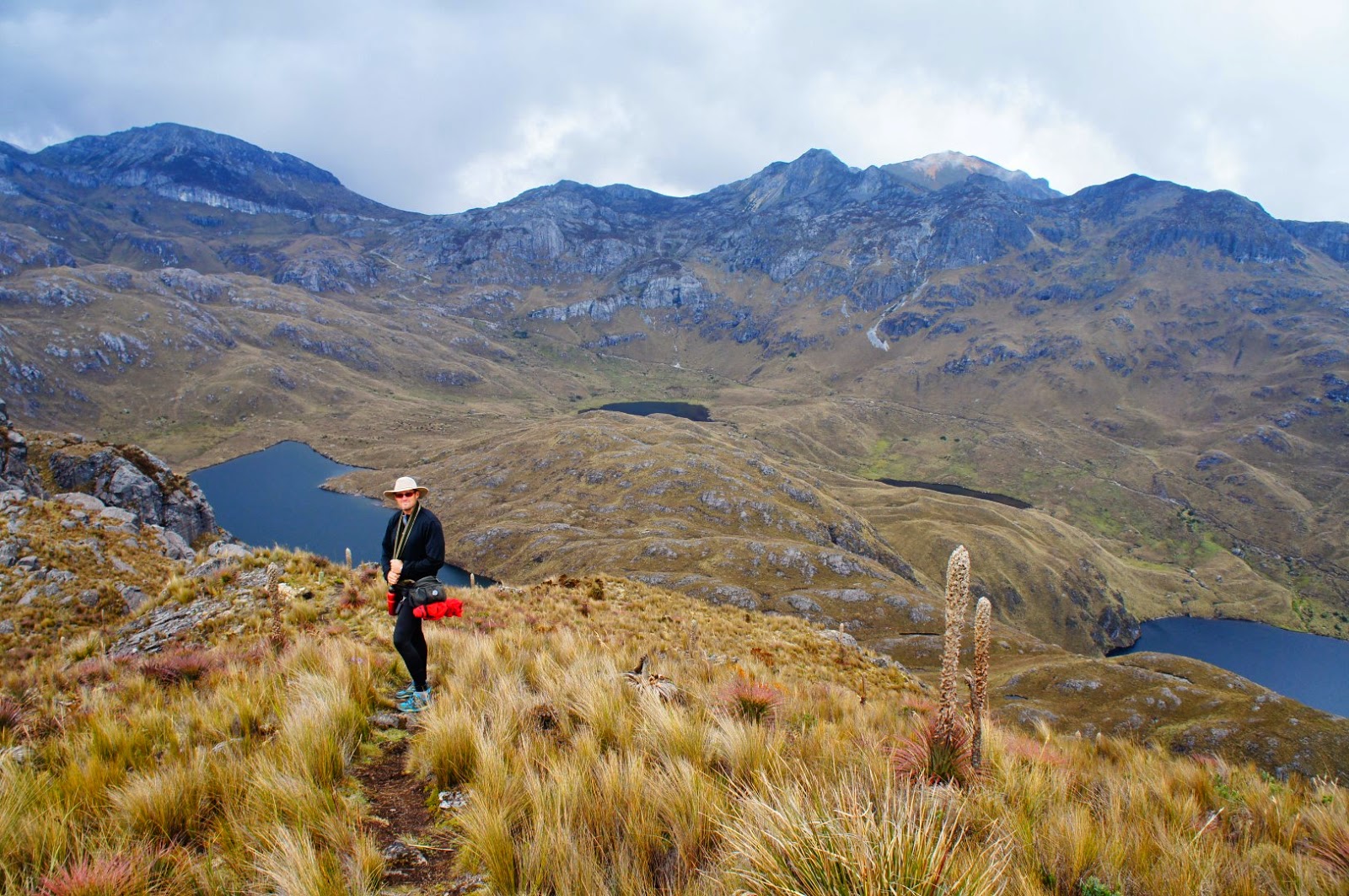
Near Cuenca (only 10 miles!!!), is a vast, spectacular national park called El Cajas. It took us forever to figure out why it was called "El" Cajas Parque Nacional instead of "Las" Cajas Parque Nacional. If you don't know why either, your Spanish is on par with ours. Like the other amazing, free national parks in Ecuador, this one did not disappoint. The park is huge, with lakes everywhere and an eerie landscape that we have never experienced before. We spent a couple of days hiking, climbing one of the zillions of peaks, and taking in the cold climate, sleeping at 12,000 feet.



We were getting close to the end of our 90-day visa, so we needed to point El Tigre south towards Peru. We read in our guidebook about an "off-the-beaten-track" town, Jima, that was nestled below some "green", climbable peaks. On the map, it appeared to be a good stopping point on our way south. It turned out to be a serious bust. It was a 10-mile detour on a steep, bumpy road that took us an hour to drive. The peaks in town would've been awesome if you had flown in from, say, Kansas, but not when you've been touring the volcanoes further north.

Jima is a very small town, and everywhere we walked, people stared at us even more than usual. I felt a bit overwhelmed by the attention. A couple of people stopped to talk to us in the town square, attempting to teach us the history of Jima. Really, they wanted to know how the hell we found the town. We spent the night parked on the town square, and while we were hanging in the truck, a funeral procession formed behind us. At first, we thought it might be a celebration that we would enjoy watching. Our hearts sank when we saw the tiny casket, carried by young boys wearing all white. We snuck a picture through our dusty, rear window while they were preparing for the procession (see below).


After a 6am wake up knock on the truck - as the Jima locals were setting up for the Sunday market - we got an early start towards Parque Nacional Podocarpus. Podocarpus was our last visit to one of Ecuador's amazing, free national parks. We camped at the ranger station, perched on a ridge inside the park, for two nights. We were the only people there - blissfully quiet. The mirador loop was the most physically demanding 5k hike ever. With a vertical gain/loss of probably 3000+ feet, and scrambling on our hands and feet, it took us almost 4 hours! We made it back in time for a chilly happy hour and alpen glow. Next up, PERU!

This hike was hard!

Podocarpus National Park

Monday, February 17, 2014

Back To The Mountains of Ecuador: Baños and The Surrounding Area

After spending the better part of our 90-day visa on the coast, we headed for the hills to spend our last 2 weeks in the mountains. We welcomed the cooler air and fantastic scenery. One of the dilemmas with heading to the mountains from the coast of Ecuador is that there are not many good places to stay at a reasonable altitude in order to acclimate. Within 50 miles, you climb from near sea-level to 10,000 feet. This is a recipe for headaches, gastrointestinal issues, and a restless night's sleep. 

Our first stop was Sangay National Park where we peaked at nearly 12,000 feet. We had to drive ourselves back down the other side of the continental divide to find a suitable altitude for our first night's sleep. Sangay National Park was beautiful, but a bit frustrating. It has a massive, paved, winding road right through the middle of it, but no pull-offs, hiking trails, or tourist services at all.  There are towering peaks, deep gorges, lakes, and waterfalls right on the edge of the road. It was gorgeous, but the clouds were pretty thick, so our pictures don't do it justice.

Sangay National Park - deep gorges and towering peaks covered by clouds

In our effort to find a hiking trail, we ended up walking up a trail that led us to some religious offerings. We aren't really sure what the story is -- whether it is related to Christianity, the local indigenous religion, or most likely, a mixture of both. This lucky god received a chicken (pluck it yourself, god), rum, a bunch of fruit, and some greenery. Unlike the other offerings, this one even had it's silk cloth pegged to the ground.

The gods do not go hungry in Sangay National Park

We gave up on Sangay NP after staying for 2 nights because of the wind, clouds, sleeting rain, and lack of accessibility. We had to make a decision about our next stop. Baños was a logical destination, but we weren't sure if we would like Baños. We had read that it was a tourist zoo - zip lines over river canyons, crowded hot-spring baths, etc. We made the decision to go, and we are so happy that we did. We absolutely loved the area surrounding Baños - towering green peaks, a deep river gorge, waterfalls galore, and a giant barren volcano overlooking it all. We ended up staying in the area for a week.

The nighttime scene at the main hot springs in town. People were packed in there like sardines.
At least they were all wearing shower caps.

Our first night in Baños we parked out of town at a popular overlander stop (Pequeño Paraiso). The location was far from town and the parking situation was very tight. For that reason, we recommend that other travelers email ahead of time to see if they have room. For the rest of the week we found free parking in some amazing locations throughout the area that were much better. 

The night view of Baños from one of our fantastic camping spots.

When we arrived, it had been raining really hard in Baños for the previous 4 days and the forecast suggested there would be no reprieve. The owner of Pequeño Paraiso recommended that we leave Baños immediately to go somewhere with less rain and mud. We were really confused about the advice, as it seemed silly for us to drive all the way to Baños to literally turn around without even seeing a waterfall!

The river gorge right in the town of Baños


We stuck around, and the rain let up after only one day. Que suerte (how lucky)! We visited all of the big and more popular waterfalls as well as the infamous Casa de Arbol (treehouse) with a swing overlooking the volcano and the valley below. Not bad for a place we were hesitant to visit! Pictures below:

How would you like to be the dudes who had to construct this stairway?


Scott was quite weary of the integrity of this swing, but that's not why he's wearing a helmet
(we rode our bikes to La Casa de Arbol)

Monday, February 3, 2014

Two Tiny Ecuadorian Surf Villages: Mompiche and Engabao

For the locals, these are fishing villages, but for us, it was all about the surf. Until 6 years ago, there wasn't even a road to the little town of Mompiche. It was perfect for us. It is still fairly gritty and has few services compared to it's famous surf neighbors further south (Canoa and Montanita). We ended up spending 3 weeks in Mompiche.

Sunflowers in Mompiche

Heather getting back to her roots

The end to another lazy day in Mompiche

The town has a hippyish, relaxed vibe, where everyone walks barefoot through the sandy streets. The tap water is almost as salty as the ocean. Many of the residents of Mompiche are of African descent, which is common of the northern beaches in Ecuador. Mompiche is also notably poor - most of the residents who live behind the hotels, hostels, and restaurants, live in bamboo houses on stilts. As for climate, the north coast is quite a contrast to the central and southern coast. These northern regions are quite green, humid, and tropical.

Great quote.. a non-literal translatation is something like, "Lift your anchor in order to get somewhere"

Life imitating art

Mompiche is where we finally tried bolones (we call them "fry biscuits"). Balones are smashed plantain dough stuffed with cheese and/or other goodies and, of course, FRIED. In Mompiche, the extra goody was tuna. Each one set us back a dollar. We learned about balones from a fellow traveler who happens to be a plantain and balone connoisseur.

Two different kinds of fry biscuits. Tuna-filled and cheese-filled. YUM!

While we were surfing and lazing about Mompiche, Christmas and New Years Eve passed us by. We didn't end up doing anything special for either. We were apprehensive about spending the holidays on the beach, as this is the most crowded time of the year. The day we arrived to our hotel/campground, we were the only ones parked in the lot. As expected, a few days later, the Ecuadorians, and a few other South Americans, arrived in droves. We counted 30 cars with many double parked. It worked out okay, and in fact, we found it interesting to watch the families and young backpackers from Ecuador, Colombia, Peru, and Argentina spend their holiday relaxing on the beach (even during the typical daily rain shower).

Sunset from our campground. Enjoying the view with the other holiday-makers.

After our time in Mompiche we retraced our path south. We stopped at Rancho Bonanza (previous post) to spend a week fixing our fridge. We had already visited much of the central coast, so we hit all of our favorites spots, while moving pretty quickly to the small southern beach town of Puerto Engabao. Although this town is tiny, it has a massive fishing fleet. Our guess is there are maybe 200 brightly painted boats that call this town their home.

Only a fraction of the fishing fleet on shore in Puerto Engabao

Each boat had some sort of a saint/religious figure painted on the side.
Some also added their own flair like a flaming yin-yang and a surfing penguin.

Each day, the fishermen head out to net shrimp, and each night, the other half of the fleet heads out to net fish. We watched the fisherman fearlessly run their boats up on the sand, using the breaking waves as a cushion. Everyday, the heavy outboard motors were removed and carried by hand to a safe storage location.

Carrying the giant nets and motor back to storage

We couldn't get enough of all the cats hanging out in the boats. I guess it makes sense - if you were a cat, where would you hangout for a picnic?

Kitty captains

We can still see you!

Engabao was our last stop on the awesome Ecuador coast before heading inland to the mountains before our 90-day visa expired.

Tuesday, January 28, 2014

Liquor Without The Hangover - Rancho Bonanza, Ecuador

Finding quality beer in Latin America is starting to become a little easier! You may remember our trip to the brewery in Buga, Colombia to hunt down some good IPA. Two months later we managed to find a restaurant/campground/brewery outside of the gritty town of Portoviejo, Ecuador, called Rancho Bonanza. We found Rancho Bonanza thanks to our friends from The Long Way South, who stumbled upon it on TripAdvisor, while looking for a place to eat and camp for the night.


Joe (aka Joaquim), the owner of the brewery, is a German guy who moved to Ecuador 20 years ago. His beer brewing exploits started after he spent some years distilling liquor - namely whiskey. The sign outside of his distillery says "Licores sin chuchaqui" (Liquor without a hangover). My guess is that he can't say the same for his beers.

Given that Joe is German, it was no surprise that his brews lean towards the smooth and malty end of the scale - no Cascade hops for this guy! On our second visit to his brewery he offered us a taste of his latest lager. It was delicious (one of our favorites), with a stronger hop undertone than his other beers. Joe let us know that this one wasn't his favorite, as it's IBU (International Bitterness Unit) rating was a bit high, at 35. We chuckled, given most of the beers we covet in the USA have IBU ratings between 70 - 110. Lucky for us, we also have an appreciation for the more subtle beers that Joe brewed!

Joe's main business at the moment is manufacturing large scale micro brewing equipment.

During both of our visits, Joe allowed us to camp on his property for free. But as you know, nothing in life is truly free. He gave us free reign of the tap as long as we kept track of how many we drank. Joe definitely got paid.


Our second visit to the brewery happened after our 12-volt fridge developed a refrigerant leak. We immediately emailed Joe and asked him if he knew of a refrigeration technician. Sure enough, he told us he would have his guy meet us at his place anytime we wanted. Carlos was an eager and helpful technician, but was only able to get so far with fixing the fridge. He didn't have experience with 12-volt fridges, which are extremely sensitive to refrigerant charge. Carlos wanted to give up at the end of the second day, but Scott talked him into coming back the next morning. When he arrived, Scott bought Carlos' tools and finished the job himself. A+ for effort Carlos...

Joe, Carlos, and Scott on Day 1
Scott's setup, Day 3. Joe let him borrow his scale and a cool laser thermometer gun

Having Joe's place to work on the fridge was incredibly helpful. He's the type of resource that every overlander dreams of finding. We left Rancho Bonanza with a sigh of relief, as we finally had a cold fridge (after 2 weeks without one), and 2 cases of cold lager to put in it. As a side note: if anyone is looking for a good 12-volt refrigeration technician, Scott's your man!


Monday, December 30, 2013

Our First Taste of the Ecuador Coast - Leaving the Mountains of Ecuador

As we drove from the central Andean mountains to the coast of Ecuador, it took a measly 50 miles to drop from 12,000 ft to 1,500 ft in elevation (steep!). A cursory check of our living quarters revealed water dripping down the mirror. The interior of our cabinets were wet, as were our clothing and food containers. This was a true lesson in the physics of humidity and condensation.

The drive from Quilatoa to Santa Marianita took us 9 hours. The total driving distance was only 180 miles!!! There was a bit of construction, a few very badly pot-holed sections, some sloooow twisty mountain roads, and of course, lots of awesome new roads. Interestingly, Ecuador is paving and/or repaving all of their roads, and for the most part, have the best roads we've driven in the Americas.

Over the following couple of weeks, we slowly worked our way down the coast hoping for some surf. We found some stunning, secret camping spots. The first was just north of Punta San Lorenzo where we had a quiet and peaceful night of sleep.

Outside of San Lorenzo

Just a bit south we happened upon another gorgeous beach with a quiet, free camping spot. The best part was the characters we met when we arrived. They had just camped for 5 days at this beach and were packing up to leave. They were 2 young French guys and 2 Argentinians traveling in a VW Bug. Their car battery was dead, a rear tire was flat, and their jack was broken.  No worries. Scott loaned them our jack, they changed the tire, and per their usual routine, 3 of them push started the car, in reverse, as they left.

Scott supervising the push start

Loaded down and ready for adventure

La Policia - pic courtesy of Wikipedia
An odd thing happened on our 3rd night camping here. Nate and Sarah showed up and decided to spend the night, as well. As the sun was setting, la policia truck arrived.  One of the officers flippantly told Sarah (who was on the beach) that we couldn't spend the night. Then, quickly drove off. We found them parked a little bit down the beach where we asked for more info. Something about it being "owned by the community" and "not safe". This seemed awfully fishy, but we really had no choice. Luckily there was a nice campground about a mile up the road overlooking our prior camp spot. It wasn't as nice as parking right at the beach, but it did have a nice view of the ocean and Salango Island. There, we learned that the beach spot was not owned by the community, but by a Swiss guy who lives in Guayaquil. Later, we read a blog post from an overlanding family who had a picture of our "secret" camp spot. I guess it's not so secret and I also guess la policia are not too diligent about kicking people out. A week and a half later we stayed at the camp spot for another 2 nights without incident.

La policia beach

A view from the Isla Mar campground that we retreated to, after getting kicked off the beach
Continuing to take advantage of Ecuador's free national parks, we hit Los Frailes beach in Machalilla NP. Here, we found a beautiful white-sand beach without a speck of trash. We spent the entire day at the beach hiking, snorkeling, and swimming. Unfortunately, the rules stated we had to leave the park by 4:30 pm.

Los Frailes beach

Since there were waves in the forecast, we drove south to the famous surf spot at Montañita. We feared that it would be hard to find a nice camp spot like those to which we had become accustomed, so we arrived prepared for disappointment. Montañita is known as a "party town" and has a pretty developed scene of random beach side accommodations, bars, and restaurants. We couldn't believe it when we found a camping spot on the beach, right in front of an abandoned public amphitheater (see pic), and most importantly, right in front of the surf break. We fed the local beach dogs and had some barking security, too.

Montañita beach camping

The security team

Cow vs. dog stand-off in Montañita

The waves did arrive and we got a bit of surfing in before we left, due to the crowds. A few days later, we started another beer mission, similar to our Buga pilgrimage. Stay tuned for our inland detour to the microbrewery/distillery of Rancho Bonanza.