Sunday, September 21, 2014

The Southwest Circuit of Bolivia

After the Salar de Uyuni, our next destination was the "southwest circuit" of Bolivia. It's well known for it's Mars-like landscape on a very high-altitude plain around 15,000 feet (4500 meters). The southwest circuit was everything we expected - bad roads, volcanoes, crazy rock formations, odd-colored lakes, hot springs, icy winds, DUST, a bazillion stars, llamas, and lots of flamingos.


Asking a local for directions

One of the awesome camping spots we found during our drive

Hot springs at 14,000 ft - blissful

The circuit lived up to it's legend with horrible roads and the feeling that we were really out there. It no-doubt tested the structural integrity of El Tigre as well as our bodies. Sleeping at 14,000 feet was still a little difficult, and we had to be careful to drink tons of water and not consume too much food or alcohol. Where's the fun in that?

Sandy, washboard roads as far as the eye can see

We also struggled with the freezing temperatures. Every evening we parked the truck facing due east so that we could pop the hood in the morning and warm up the engine block. Scott was very pleased that the truck easily roared to life every morning. We also switched bedrooms - from the poorly insulated top bunk to the warmer sofa bed. We drained the water heater every night, and opened our cabinets to expose the plumbing to our body heat. Normally, we collect our shower water to wash the truck in the morning, but that was impossible with a 6 inch block of ice in the bucket.

Eating up some sunshine

Laguna Colorada is the most famous and picture-worthy destination on the circuit. It is a shallow, pink lake (due to algae) flanked by large mountains and covered with flamingos! Very picture-worthy indeed.


We had to take a side road up (and I mean UP) to 16,500 feet at the Bolivian customs office. It was 45 miles from the actual border. So weird.


Laguna Verde - green due to suspensions of arsenic and other minerals 

Just as we were exiting Bolivia near 15,000 ft (at the crossroads between Bolivia, Chile and Argentina), we saw a guy BIKING up from Chile. I couldn't believe that he was about to do what we just did ON A BIKE with A TENT! How in the...? I would love to chat with him about his life and adventures. We did get a picture of him (below), to remind us of how lame we are.

Stefan writes a blog at www.showmetheworld.net

Sunday, September 14, 2014

The Salar de Uyuni, Bolivia

For nearly 5 years, I've been reading the blogs of fellow overland travelers on the Pan-Am. From these blogs, one of the most intriguing places was the Salar de Uyuni in Bolivia, as well as the wild, entrancing high-altitude landscape southwest of the Salar. Secretly, I always wondered if we would make it there. I know that Scott is no fan of teeth-chattering roads, water-pipe freezing temperatures, and sitting in a vehicle for hours on end, just to see a few cool landscapes. For years, I kept my expectations low for the possibility of visiting the area.

The closer we got to the southwest of Bolivia, the more it seemed like Scott was willing to make it happen. He wasn't dying to go (he thought he was dying for other reasons), but felt that if it was important to me, he would do it. For me, not visiting southwest Bolivia was like passing up an opportunity to visit the moon - sure, it comes with pain and consequences, but...it's the moon!


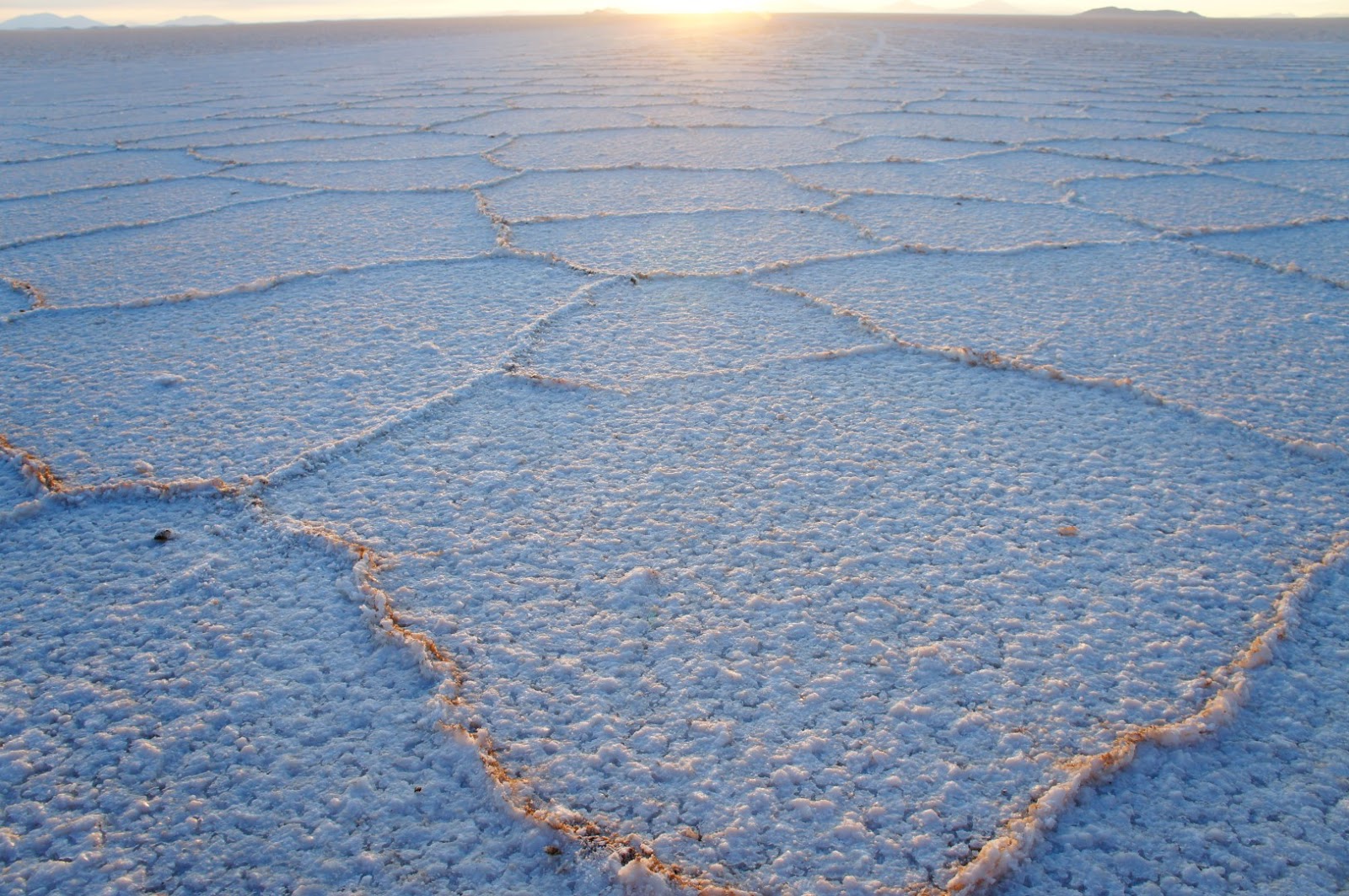
The Salar de Uyuni is the largest salt flat in the world. It is approximately the size of Connecticut and sits at an elevation of 12,000 feet. It boggles the mind with it's flat, white expanse.


We were a little bummed at the end of the dry season that from certain angles the Salar has a bit of a brown tinge, due to the blowing dust. 

The salt is 20 - 300 cm thick and each rainy season, water sits on the flats and melts it into an almost perfectly flat surface. It's nerve-racking to know that you are driving across a salt crust that is only 20 cm thick in places. Under the salt is a lake of lithium-rich brine. The lithium accounts for an estimated 50% of the world's reserves. So far, a Bolivian company is mining the lithium on a relatively small scale, and has managed to keep much of the wealth in the country.

Before we drove onto the Salar, we hiked up a volcano (Tunupa) on the north end for an incredible view over the expanse (picture below). Unfortunately, a hard climb at such an altitude was a bit much, and I was really feeling ill the next day.

A view of the Salar from above


Some skittish vicunas on the Salar in front of Tunupa volcano

Finally on the Salar, we were inspired, like all other travelers before us, to play around with the camera. Due to it's flatness, monotone color, and blue skies overhead, the Salar is an epic place to trick your eyes and camera. Here is a sampling of our efforts:


When the sun went down, the temperatures dropped fast


The next day, we zoomed across the Salar (easily the best road we traveled in Bolivia) at 50 mph and headed to Uyuni, the nearest town, for fuel, a car wash, and supplies in anticipation of the next adventure into the National Reserve of Avaroa - next post!

Practical Information For Fellow Travelers:

Camping:

  • Jiriri (on the north edge of the Salar): We parked near the hostel in this tiny town at the edge of the Salar. It's a good base to climb the volcano, Tunupa. If you are looking for accommodations or just a hot shower, the people here are really nice and the hostel looked clean and well-kept.
  • The Salar: We read that camping on the Salar was illegal. We assume because they don't want fires and/or going to the bathroom on the Salar. We camped in the middle of the Salar but didn't do any of that.
  • Uyuni: We parked/camped outside the hotel that houses the famous pizza place. It WAS as good as you hear. If you need to buy water (which you undoubtedly will), you can get large 20 liter refills at Agua Purisimo. Many people in town had no idea where we could get water in botellas grandes, so this felt like a really good find.

Maps and GPS:

  • We used the information from AtoB, LifeRemotely, and PanAm Notes. The waypoints, free Garmin GPS maps, and general recommendations were very helpful. 

Tuesday, September 9, 2014

Sickness and Recovery in Arica, Chile

We fell into a comfortable pattern of life while hanging out in the small Chilean town of Arica for almost 3 weeks. Scott was recovering from his self-induced lung infection, and we were checking things off our chore list in anticipation of isolated, cold, and harsh exploration of the Bolivian altiplano.

Arica was our introduction to Chile. We couldn't believe that each day, a team of people would fan out along a 4-mile stretch of beach to clean all of the trash. The team took their job so seriously that they would collect dead birds and even dead seals! Similarly, the town was clean and walkable, with pedestrian streets and the absence of smoke-belching vehicles. I think we're going to like Chile!

Streets performers were abundant in Arica - always something colorful and different to watch

The few lucky garbage collectors rode a slide attached to the back of a tractor and
by the end of their shift, they would sit on their piles of garbage

When we tried to leave Arica the first time, we were heading to the high-altitude border between Chile and Bolivia. We made it to within 20 miles of the border. We were both feeling the effects of the altitude, and I had somehow contracted a cold virus that knocked me to the ground. Reluctantly, we drove 80 miles and 13,000 vertical feet back to Arica to recover in the comfort of the beach. Poor Scott, still trying to recover from his feather-hell, got my cold virus as well. Finally, in relatively good health, we headed back up to Bolivia. This time, we made it.

The route from Arica to Bolivia is a steady climb from sea level to an altitude of 15,000 feet over about 100 miles!!! The drive took us through mountainous desert landscapes where we slept under more stars than we have ever seen. We spent one night in the parking lot of a hot spring pool at 13,200 ft (Termas Jurasi). The air was quite cold, while the too-hot-to-touch water pouring out of the hillside filled the pool with crystal clear mineral water.

This was the first time we had seen the unique Candelabra cactus 

A starry and chilly night next to the campfire as we climbed up to the Bolivian border

Termas Jurasi - you can't tell from this picture how cold the air was or how hot the water was

Just before reaching the border of Bolivia, we were treated to a wild landscape of lakes, llamas, and giant snow-capped volcanoes. It was a foreshadowing of the landscape we were about to encounter in Bolivia - stay tuned!


Practical Information For Fellow Travelers

Camping: 
  • Arica: Camp for free on the safe and monstrously long beach in Arica. Beware that each Friday and Saturday night, the locals will join you with thumping music until 6 am. The only reprieve we could find was driving to the very end of the beach (5 miles out of town) off the dirt road. If you have time, walk up the giant headland for a great view over the ocean and city. Park along the ocean road near the port for easy access to the town and headland.
  • Putre: We parked/camped in front of the German-owned hotel right as you enter town (Hotel Las Vicunas). If you are having altitude sickness, you can go to the clinic right as you enter town for a free dose of oxygen.
  • Termas Jurasi: This place was great to spend the night - no one is around at night so you have the hot springs all to yourself!
Border Crossing: 
  • We crossed into Bolivia at Tambo Quemado.We had to drive around miles of trucks who were waiting to get weighed, to get to the actual border. 
  • WE SHOULD'VE FILLED OUT OUR VEHICLE PERMIT PAPEWORK AHEAD OF TIME ONLINE and printed out the necessary entry form. Since we didn't know about this, we had to pay an agency to do it for us (it was cheap). 
  • Americans have to pay $135/person for their visitor visa. The customs agent was not happy with our $20 bills, he wanted $100 bills! He wouldn't take anything but the newest crispest bills - be aware. 
  • The border is at a very high elevation and it's windy, cold, and DUSTY.

Tuesday, August 19, 2014

Smuggling and Hovering -- Peru and Chile

by Scott

One of the bigger hassles for overlanders is the inevitable vehicle repair. Finding parts is hard. Finding good mechanics is even harder. I recently lucked out on both fronts.

While back in the states, my shopping list included an air box, coolant sensor, various filters, assorted gaskets, caliper pins, wheel studs, shock bushings, fuel injectors, and glow plugs. Imagine the pit in my stomach during our flight to Peru when they handed us the customs form that specifically called out the restrictions on auto parts, boat parts, motorcycle parts, and RV parts! Used parts are an absolute no-no, which included the air box and the rebuilt injectors, and new parts must go through an extensive and expensive import process.

A small sample of what was in our baggage

Rather than sleeping through our red-eye flight, I came up with a plan. We would not declare any of this stuff. Instead, if we got questioned, we would insist that the parts were for a Peruvian friend with an off-the-grid beach house. Truck? What truck? These parts are for a diesel generator!

While waiting at baggage claim, we observed the process at customs. All bags went through the X-ray, but people were not being searched. So, I stuffed my pockets with injectors, and Heather put the glow plugs in her purse. These were the small, but expensive parts. The rest stayed in our luggage. We chose the line with the two young female scanners, making the sexist assumption that they might not recognize car parts. It was 2am, so maybe they were just sleepy, but either way, it paid off. We walked through customs with a thousand dollars worth of undeclared parts for El Tigre. I didn't even get to use my well-rehearsed generator story.

The next step was to find a mechanic. I usually do all the work myself. The couple of times we've used mechanics have confirmed that no one else should be allowed to touch El Tigre. This time, though, I was nervous about doing it myself. I had never changed glow plugs or injectors, so I decided to leave it to a professional.

At the grocery store in Arica, Chile, I approached a guy who had an "HR Diesel" sticker on his truck. He recommended them, so I went there first. However, they refused to work on Chevy diesels, as they are extremely rare in South America. I went down the street to "Canchaya Diesel", another sticker I saw at the grocery store. It was siesta time, so we waited...and waited. I finally decided to walk around the block to see if there were any other options.

Beyond these gates is an overlander's oasis

As luck would have it, "Centro Diesel Turbo" ended their siesta a bit earlier than their competition. Jonathon, the mechanic, was super friendly, and told me to bring the truck over. He and Flavio, the owner, looked over the situation, and we all talked about our concerns. They gave me a short tour of their facilities to convince me that they could handle any unanticipated difficulties. They had an onsite welding shop, machine shop, and injector laboratory. Oh, and they'd do the job for less than $100 USD!

Don't judge a book by it's cover, this place was outstanding... and a really quiet campsite

We returned the next day, and I spent 7 hours hovering over Jonathon. He was the ideal mechanic--patient, methodical, and meticulous. I couldn't believe when he asked for the torque specifications for the injectors. I was even more surprised when he pulled out his torque wrench. I thought for sure he'd just go by feel. Are we still in South America?

Jonathon only lost his cool one time when I was trying to help a little too much

We ran out of daylight with a few more injectors to go, so we slept in the lot. It took Jonathon another 3 hours the next morning to finish up. Meanwhile, Flavio took me into the lab to test my old injectors to see if any were suitable for spares. Though the job took a little longer than expected, they stuck to the original estimate...less than $100 for 10 hours of labor! I gave Jonathon a $20 tip for the Spanish lessons, the injector tutorial, and especially the hovering. These guys can touch El Tigre any time.


It was worth the money just to not have to contort myself into the wheel well