Tuesday, May 6, 2014

EarthRoamer Drool

by Scott

A few weeks ago, we got a fantastic surprise. Our friends, Todd and Shonah, quit their jobs, sold their possessions, and are hitting the road to live full time in their EarthRoamer. Some of you who read our blog may know Todd. We attended Purdue together, lived together while interning in Los Angeles, and did annual ski trips for many years. Check out ShonahAndToddsTravels to follow their adventures, or to just drool over their rig. Congratulations guys -- see you somewhere!

Their Rig:


A few pictures from the past (sin grey hair and wrinkles):

2002 in Montana: Scott, Shane (Scott's bro), Doug, Todd, Heather

Scott, Heather, and Todd (2006) - Funny thing about this pic is that we all still use the same jackets!

Shonah, Todd, Scott, and Shane

Thursday, April 24, 2014

The Peak Of Our Trip - Cordillera Blanca, Peru

When we started this trip, I had certain notions of what South America would look like. The Cordillera Blanca in Peru is exactly what I had envisioned for the Andes mountains that stretch all the way from Venezuela to Argentina. The Cordillera Blanca is overwhelmingly dramatic, with snow-covered 21,000 foot peaks, granite cliffs, glaciers, emerald blue lakes, and waterfalls everywhere you look. Our Lonely Planet guidebook nailed it when it described the area: "One of the most breathtaking parts of the continent, the mountainous region of the Cordillera Blanca is where superlatives crash and burn in a brave attempt to capture the beauty of the place". Indeed.

We ended up spending 2 weeks in the Cordillera Blanca mostly hiking and driving El Tigre on the worst roads he's ever seen (at least with us at the wheel). Unfortunately we hit the mountains during the wet season, so many days we had to work hard to finish our adventuring before the afternoon downpours started. The upside, no crowds. Most of the time we were completely alone.

While we were aclimating to the area, we drove through the Canon del Pato which has 35 scary 1-lane tunnels through an impressive and deep canyon.


One of the short tunnels

Our first adventure in the Cordilleras ended in failure. We started 4,500 vertical feet below the famed emerald Laguna Paron, flanked by what is said to be the Paramount Pictures mountain. Instead of driving the truck up the horrible road, we decided to bike to the lake. The climb was intense, and took us way longer than we had antipicated. It rained and even hailed, but we persevered for an hour past our self-imposed turn-around time. We gave up just half a mile short of the lake. Our heads were pounding, the sun was setting, and we were cold, bordering on delirious. After all that, we never got to see the lake and certainly not the mountain. FAIL.
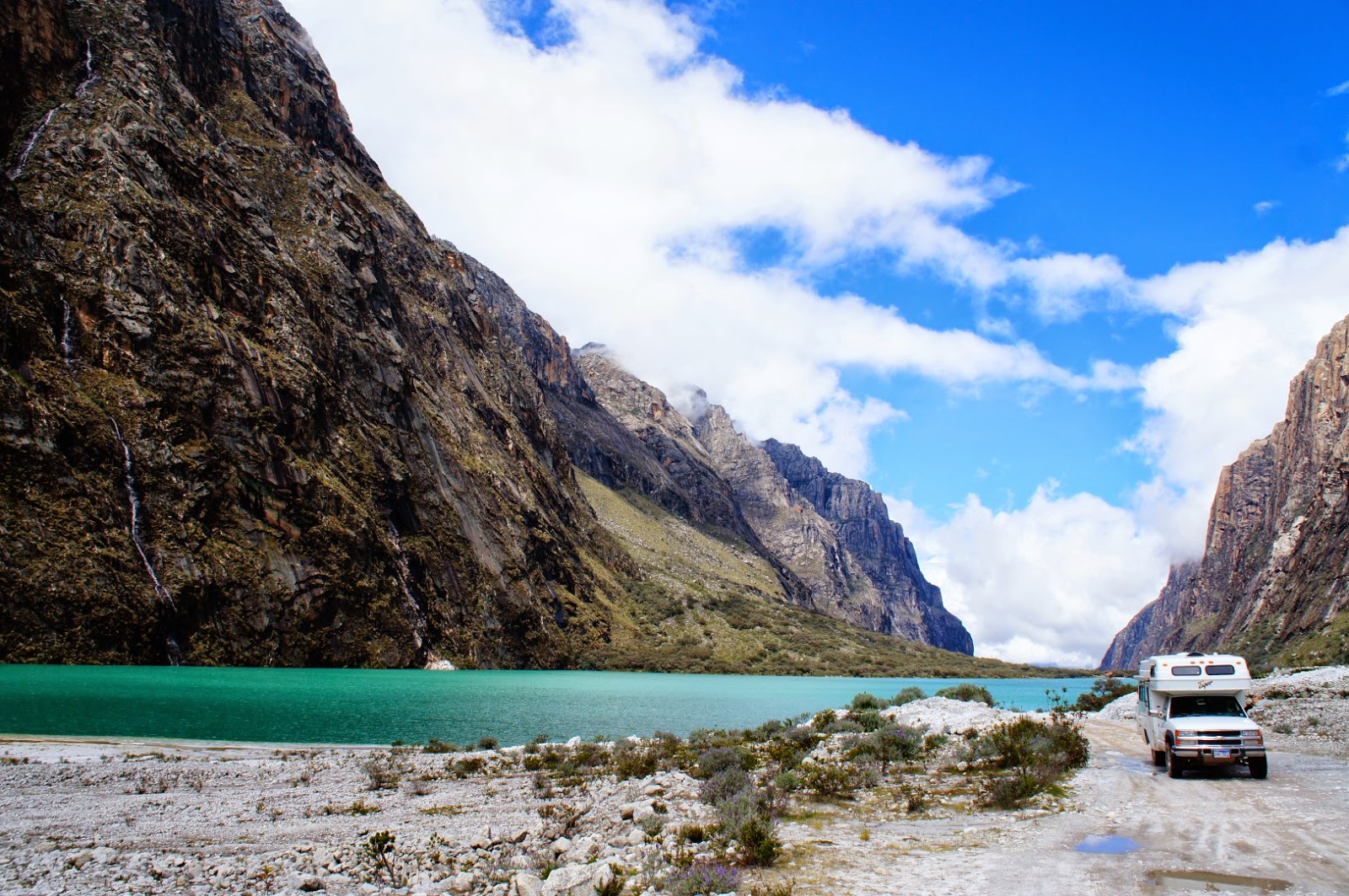

Llanganuco Lake

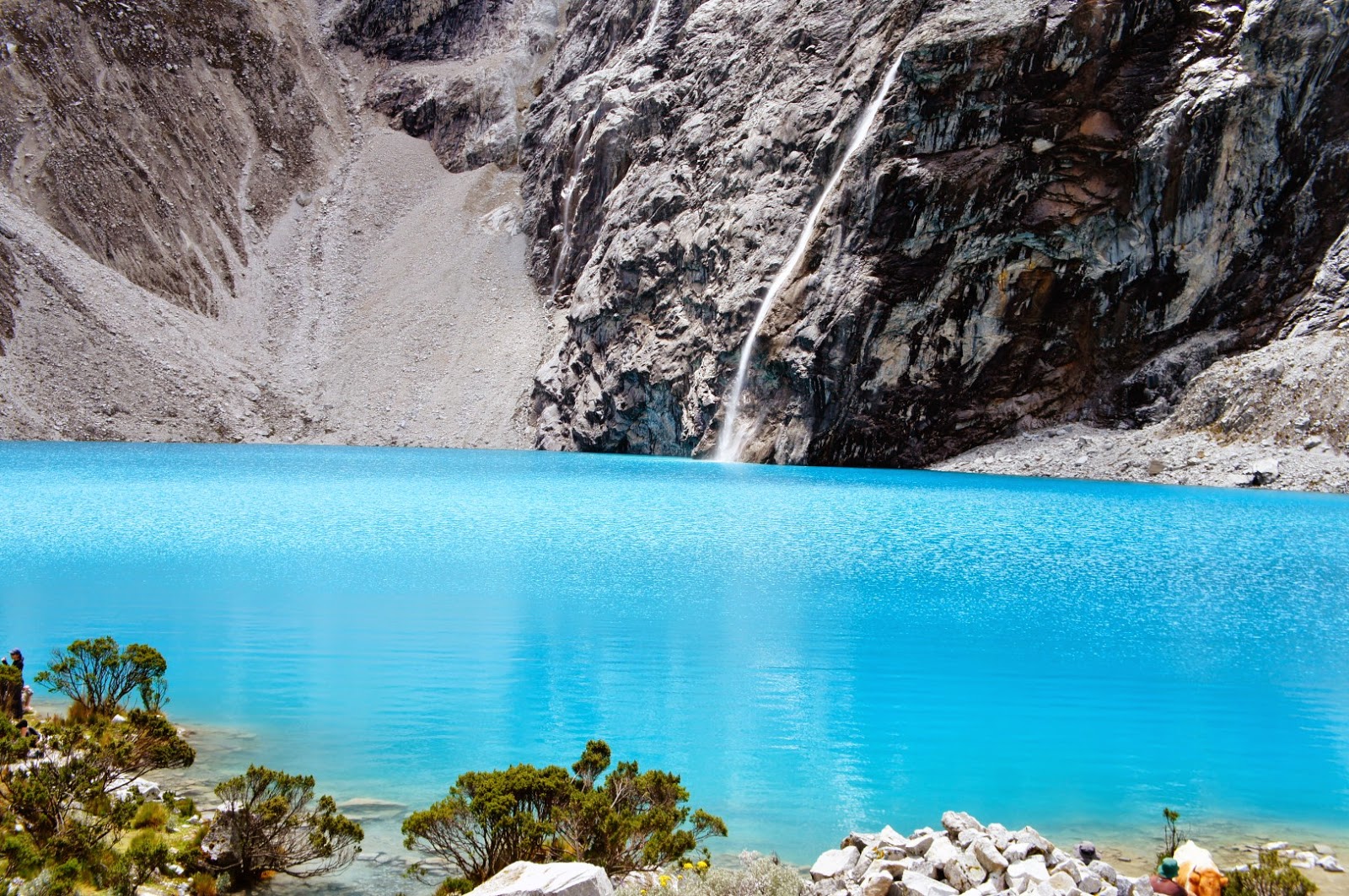
After this mishap, we were more willing to drive the truck closer to our intended destination. Our favorite was no doubt the hike to Laguna 69. We hiked for a few hours at around 12,000 - 13,000 ft, past dramatic cliffs and waterfalls, catching glimpses of giant snow-covered mountains above us. The hike ended at the much anticipated Laguna 69. As I rounded the corner to see the glowing blue lake ahead of me, I stopped in my tracks. It was quite literally an unbelievable color. To add to the beauty, there was a 20,000 ft mountain peaking out of the clouds right above it, with a little waterfall pouring into the lake. This was the only hike where we saw tourists. Even during the wet season, people brave the cold and rain to see this beauty.

Strolling among the giants

The first glimpse of Laguna 69

Laguna 69

Cattle Battle at our campsite. The cows rubbed and licked our truck all night. They won.

Our only bad experience in the Cordillera Blanca was when we drove up a rugged valley towards the peak known as Huantsan (accent a) with Laguna Rujucolta as our goal. While we drove up the valley, on a rough road barely wide enough for El Tigre, we passed mud houses and quite a few people who wouldn't return our wave, all the while giving us the stink-eye. This was contrary to the smiles we saw in the other valleys. In retrospect, we should've taken this as a warning.

After an intense drive through river beds and narrow 4WD-required switchbacks, we stopped at a river that had washed out the road. We slept on the side of the road, and in the morning, headed to the trailhead by foot. Once in the national park, the ranger walked with us for a while. We struggled to communicate because his first language was also not Spanish (Quechua is the indigenous language of the region). It was definitely like a couple of 2-year olds trying to communicate. He was trying to tell us that it was not safe for us to leave our vehicle alone, but it took us about 10 minutes of back-and-forth "what-did-you-say" before we realized what he was getting at. He told us that the locals would slash our tires and throw rocks at our vehicle. Just to make sure we understood, we asked if we should abandon our hike and immediately return to the truck. His answer was an unequivocal and emphatic yes.

At that point, Scott handed me all of his gear. He ran back to the truck, while I walked, all the while ruminating about how I would deal with slashed tires or broken windows. As I walked, a lady whom we had encountered on our way up was 50 feet above the road crouched behind a rock. She was screaming Quechua curses at me as I passed. She continued until I was out of her sight. I couldn't understand anything she said, but it was intense. It definitely scared me, and seemed to validate the ranger's advice. I returned to the truck only 15 minutes after Scott had arrived, and all was good. We took a deep breath and drove back down the insane road to the highway.

Unique plants of the Cordilleras

The next day, we drove El Tigre up to 16,000 ft and climbed up to the Pastoruri glacier. As we ambled around, we realized we were close enough to 17,000 ft that we should make it a goal for the day. We made it to 16,936 before having to turn around because of steep snow-covered scree that we couldn't climb. Almost!

The shrinking Pastoruri Glacier

16,936 feet above sea-level - couldn't even get ourselves to 17,000 ft!  So close


Other days, we just headed up into random valleys. With just a little bit of research, we found trails, mountains, and lakes that probably rarely see tourists.

An umarked trail to a peak we didn't even know the name of

Ho-hum...just another spot in the Cordillera Blanca unworthy of being named on a map

Superlative alert. The Cordillera Blanca is one of the coolest places we have ever been. The massive scale of the mountains, cliffs, waterfalls, and lakes, paired with the accessibility, make this place one of our all-time favorites. Can Patagonia top this, or should we just turn around now?

Monday, April 7, 2014

Surfing, Cool Water, and Deserts - Nope, It's Not Baja

At first glance, the northern coast of Peru appears mostly like long stretches of barren desert between dusty towns and dirty fish camps. If you scratch below the surface, just a little, you find awesome little beach coves, world-famous surf breaks, and even some giant mountains/dunes beckoning you to climb. A lot of the north Peru coastline reminds us of the Pacific coast of Baja - cold water, sparse tourist infrastructure, beach camping, and uncrowded surfing.

After kiteboarding, surfing, and speaking embarrassing Spanglish with our new friends in Pacasmayo, we moved on to the famous surf point of Chicama (it's known as "the longest wave in the world"). Here, we surfed, but most notably, we started our daily habit of seeking out lucuma marcianos. Lucuma is a fruit endemic to Peru that has a sort of maple flavor. It's mixed with milk and probably a lot of sugar and put in a plastic bag to freeze into what they call a marciano (popsicle?). They are about 15 cents and are absolutely addictive.

Lucuma marciano - yum!

One of the locals in Chicama

Sunset over Chicama


After Chicama, we zipped our way down the coast. We made a stop at Huanchaco, famous among travelers and Peruvians for it's easy going beach scene, surfing, and the iconic reed boats that the locals still use for fishing (pictured below). We camped in a beach parking lot that was on the beach. We thought it was a great idea, until night fell. The problem wasn't late night partying, it was the overzealous security guards. They raced up and down the beach all night with their lights flashing, sirens wailing, and occasionally shining their spotlights on our truck. I think they thought we would like the security, but it just kept us from sleeping.

They are still using these giant single-person boats for fishing in Huanchaco

As we worked our way south, a surprise spot we found was a tiny cove called Playa Tortugas. We had fun conquering the 2000-foot dune-of-rocks right above the cove.There were tons of neighboring coves and off-shore islands that we could see from the top. The picture below was taken from the top of the mountain. I couldn't resist editing the picture with a teeny, tiny red circle around El Tigre, where we had a quiet and safe camping spot on the rocky beach.

Playa Tortugas in Northern Peru

A neighboring cove and island

While we were in Pacasmayo (previous post), we knew that we wanted to stop at a secluded surf spot called Punta Bermejo. We asked Juan Pablo if he thought it would be safe to camp on the beach. He told us it would only be safe if other people were around. Similarly, a guy we met at Playa Tortugas (above), told us it wasn't safe AT ALL. It turns out, this spot was completely quiet and safe, with many Lima residents coming to camp on the weekend. We ended up camping/surfing at Punta Bermejo for 2 weeks (only interrupted by a drive to the nearest town for supplies).

The orange and purple glow of a sunset over our campspot at Bermejo

Scott paddleboarding at Bermejo

We finally said goodbye to Bermejo, much to the relief of the local fisherman who may have been worried that we would spend the whole Peruvian summer there. Our next stop was the MUCH anticipated mountain range of the Cordillera Blanca about 5 hours away. Next blog!

Peru is much bigger than Ecuador. We covered a lot of miles over only 4 stops (Lobitos, Pacasmayo, Tortugas, and Bermejo). Unfortunately, the gas isn't cheap either (~$5-$6/gallon).

Sunday, March 23, 2014

Our Good and Bad Intro to Peru

After we stayed in Ecuador for the maximum 90-day visa, we headed to Peru. Not to beat a dead horse, but did I mention we LOVE Ecuador? The border crossing was uneventful and relatively easy. We got excited when we asked the immigration official for a 6-month visitor visa, and he obliged by stamping 183 days in our passport. When is it ever that easy? Ten minutes later, while getting our vehicle permit, the customs official told us, in no uncertain terms, that we could only have 90-days for our vehicle permit. A 183-day visitor visa does us little good without a matching permit for the truck. So close...

Lots of desert in the Northern part of Peru

Four days after our border crossing, we headed towards the beach/surfing town of Pacasmayo. After a few hours of driving, we stopped for gas outside the city of Chiclayo. Queue bad intro: I walked to the bathroom and left Scott at the truck. While he stood on the driver's side, a thief opened our side door that has a big "beware of dog" sign on it, and grabbed the first thing he could. As they drove off, the gas-station attendants went nuts, gesturing for Scott to do something. It happened so quietly and quickly, that Scott had no idea anything went down, and certainly had no idea what the attendant was gesturing about. In fact, he looked behind the truck thinking she wanted him to move, while the thief and his accomplice drove off in the opposite direction. The guy took Scott's beloved man-purse that we bought at the Otavalo market in Ecuador. The good news... it was pretty much empty! Score! We were thrown off a bit, but definitely learned a valuable lesson.

An hour later, we arrived at Pacasmayo. Like we normally do at a new location, we asked if it was okay/safe for us to park and sleep in the truck. We had gotten used to the common response in Ecuador, "Siiiii, no pasa nada" (Yesss, nothing [ever] happens). The first guy we asked told us to definitely not camp at El Faro, at the far end of the beach, where we wanted to park. For a second opinion, we asked at the police station if it was safe to camp at El Faro. Not only did the officer tell us "no", he suggested the only safe place was in front of the police station, on a narrow city street. A few days prior, a Brazilian surfing tourist had been robbed at El Faro with a gun to his head.

El Faro point, Pacasmayo. We really wanted to camp here but were warned against it by too many people.

With this news, and thoughts of our incident in Chiclayo, we set out searching for somewhere to park that had some sort of security. We ended up paying a security guard who was in charge of a large tract of private land overlooking the ocean near El Faro. As we were cooking dinner, the owner of the property, Juan Pablo, came home and stopped by our truck. He insisted we park right next to his house as he retold the story of the Brazilian tourist.

For an entire week, we stayed at Juan Pablo's, and got to know his family and friends. He lives in the giant city of Lima, but owns property in Pacasmayo, where he now vacations. These people were insanely kind, friendly, welcoming and giving. They invited us to share many meals with them, as well as join them for outings to the surrounding beaches. We were a bit shy, and I was embarrassed about my horrible Spanish, but they were extremely patient (especially Juan Pablo and his friend Claudia). They welcomed us to their country like nothing we've ever experienced. Our final night in Pacasmayo, they took us to their local "social club" where we hugged and cheek-kissed more people in one night than we have in our entire life. To say the least, we were overwhelmed by the kindness and warmth.

Our first morning in Pacasmayo. Juan Pablo and family on right with Claudia and Ticlo's family on left.

Carlos feeling like we all did, after our delicious meal prepared by Claudia's Mom.

Our last night in Pacasmayo with our new friends

Since then, we have had nothing but good experiences with people throughout Peru, and are glad that our bad intro was just that.